

This article is general information, not financial advice or legal advice. Bank policies change without notice. Check your bank’s own help page on the day you send money.
Introduction
You found an exchange. You passed the identity checks. You waited out the 24 hour cooling off period. Then your bank declined the payment.
This happens to thousands of people in the UK every month. It is not always a scam warning. Most of the time it is your bank’s own policy. Some banks publish a clear limit. Some banks block crypto payments altogether. Some banks publish nothing at all, and still block payments case by case.
This guide gives you the full picture in one place. A per bank table. The exact published limits. The banks that block transfers outright. And what to do when your payment is declined.
New to buying crypto? Start with How to Buy Crypto in the UK for Beginners. Want to compare exchanges first? Read Best Crypto Exchange UK: FCA Registered.
Which UK Banks Block Crypto Payments? The Short Answer
Six UK banks block crypto related transfers altogether: Starling Bank, TSB, Chase UK, Metro Bank, Virgin Money and the Co-operative Bank. Six more publish a limit instead of a ban: Barclays, HSBC, NatWest, Santander, Nationwide and Monzo. Lloyds and Revolut publish no crypto transfer policy, but their customers still report blocked payments. Check the table below before you send money.
That is 60 words. It is the whole answer. The rest of this guide gives you the exact figures, the evidence behind them, and the steps to take when a payment fails.
The Full Per Bank Table
| Bank | Status | Limit or rule |
|---|---|---|
| Barclays | Limit | 2,500 pounds per transaction, 10,000 pounds every 30 days. Credit card crypto purchases blocked from June 2025. |
| HSBC UK | Limit | 2,500 pounds per transaction, 10,000 pounds every 30 days. |
| NatWest, including Royal Bank of Scotland and Ulster Bank | Limit | 1,000 pounds a day, 5,000 pounds every 30 days. Attempted and rejected payments count toward the limit. |
| Santander UK | Limit | 1,000 pounds per transaction, 3,000 pounds in any rolling 30 day period. |
| Nationwide | Limit | 1,000 pounds a day by Faster Payments and 1,000 pounds a day by debit card, per current account. Credit card crypto purchases blocked. Binance payments declined. |
| Monzo | Limit | 5,000 pounds in a rolling 30 day period. The allowance cannot be changed. Binance payments blocked. |
| Lloyds Banking Group, including Halifax and Bank of Scotland | No published policy | No published crypto transfer restriction as of 28 August 2026. Payments can still be delayed or blocked case by case. Credit card crypto purchases blocked since 2018. |
| Revolut | No published policy | No published transfer cap. Crypto trading is built into the app. Transfers to some exchanges can be blocked or need approval. |
| Starling Bank | Block | Blocks crypto related transfers altogether. |
| TSB | Block | Blocks crypto related transfers altogether. Crypto purchases banned since 2021. |
| Chase UK | Block | Blocks crypto related transfers altogether. |
| Metro Bank | Block | Blocks crypto related transfers altogether. |
| Virgin Money | Block | Blocks crypto related transfers altogether. |
| Co-operative Bank | Block | Blocks crypto related transfers altogether. |
Bank policies change without notice. A limit on this page is a snapshot of what the bank published. It is not a promise that your payment will go through. Banks also run fraud checks on individual payments, and those checks can stop a payment even when it is inside the published limit.
The Complaints Behind the Table
The figures above come from a report by Stand With Crypto UK, published on 20 October 2026. It is called “Blocked: Britain’s Crypto Access Problem”. The group ran an online complaint tool for 90 days, from May to August 2026. In that time, 9,803 people sent 10,092 complaints about blocked, capped or delayed transfers to crypto exchanges. The complaints came from all 650 parliamentary constituencies.
Lloyds Banking Group drew the most complaints, with 2,297. Barclays followed with 1,569. NatWest Group had 1,278. HSBC UK received more than 1,000. Virgin Money had 103 and the Co-operative Bank had 76.
Banks that publish a limit accounted for 6,198 complaints, about 61% of the total. Banks with no published policy, Lloyds and Revolut, accounted for 2,842. Banks with an outright ban accounted for 989, under 10%.
Read those numbers with care. They are self reported, through an advocacy group’s own tool. They are not a representative survey. They are not adjusted for bank size. Lloyds is the largest banking group in the UK by current accounts, so a high complaint count partly reflects a large customer base. A January 2026 survey by the UK Cryptoasset Business Council found that about 40% of transactions to UK exchanges were blocked or delayed. A 2025 FCA and YouGov survey found that 13% of UK crypto users had problems withdrawing crypto to their bank account, the most common negative experience reported.
The report matters because it is the only public count of the problem. It also forced the issue into Parliament. The Crypto and Digital Assets All Party Parliamentary Group launched a formal inquiry into banking access on 21 July 2026, and took written evidence from banks, payment firms and crypto businesses through 31 August 2026.
Barclays, NatWest and Santander: The Published Limits
Barclays
Barclays allows transfers of up to 2,500 pounds per transaction to crypto platforms, with a maximum of 10,000 pounds over 30 days. Barclays has said publicly that it introduced the limits to protect customers from crypto related scams and losses.
Barclays blocked crypto purchases on its credit cards from June 2025. Debit card and Faster Payments transfers to exchanges are still allowed, inside the limits above.
Barclays drew 1,569 complaints in the Stand With Crypto report, the second highest total. That is not surprising. A limit that looks generous on paper still blocks anyone who wants to move more than 10,000 pounds in a month, and Barclays is one of the largest banks in the country.
NatWest, Royal Bank of Scotland and Ulster Bank
NatWest limits crypto payments to 1,000 pounds a day and 5,000 pounds in any 30 day period. The same figures apply at Royal Bank of Scotland and Ulster Bank. The limits have applied since 16 March 2023, and they cover online banking and mobile app Faster Payments and debit card payments to crypto exchanges.
There is a detail that catches people out. NatWest says attempted and rejected payments count toward the limit. If you try a 1,000 pound payment and it fails, that 1,000 pounds still counts against your daily allowance. Do not retry the same payment again and again. Each failed attempt eats into your limit.
NatWest Group drew 1,278 complaints, the third highest total.
Santander UK
Santander UK allows 1,000 pounds per transaction and 3,000 pounds in any rolling 30 day period for payments to crypto exchanges in the UK. The limit applies to payments made through mobile and online banking, phone payments, CHAPS, open banking and branches. Santander’s own page does not mention debit card payments, so do not assume a card payment follows the same rule.
Santander’s monthly cap is the tightest of the four large banks that publish limits. A beginner buying 100 pounds at a time will never notice it. Anyone moving a larger sum in one month will hit it fast.
HSBC UK
HSBC UK allows up to 2,500 pounds per transaction, with a maximum of 10,000 pounds over 30 days. That matches Barclays exactly. HSBC received more than 1,000 complaints in the Stand With Crypto report, the fourth highest total.
Lloyds and Halifax: No Published Limit, But the Most Complaints
Lloyds Banking Group is the puzzle in this story. It includes Lloyds, Halifax and Bank of Scotland. As of 28 August 2026, the group had no published policy restricting crypto transfers. Yet it drew 2,297 complaints, more than any other banking group, about 23% of the total.
That tells you something important. A bank does not need a published policy to block your payment. Lloyds runs fraud and financial crime checks on individual payments. A payment to a crypto exchange can be delayed or declined case by case, even when no written limit exists.
Lloyds stopped credit card crypto purchases in 2018, one of the first UK banks to do so. Payments to Binance are also stopped. If you bank with Lloyds, Halifax or Bank of Scotland, expect a block or a delay, and call the bank before you send a large amount. Or use a second bank account that publishes a clear limit.
This is also why the complaint numbers need context. Lloyds customers complained the most, but Lloyds also has the most current account customers. The report itself says the figures are not weighted by market share, and one customer could complain to more than one bank. The point is not that Lloyds is the worst bank for crypto. The point is that no published policy does not mean no restriction.
Banks That Block Crypto Transfers Altogether
Six banks block crypto related transfers altogether, according to the Stand With Crypto report: Starling Bank, TSB, Chase UK, Metro Bank, Virgin Money and the Co-operative Bank.
TSB
TSB has banned crypto purchases since 2021. It was one of the earliest UK banks to take this step. If you bank with TSB, do not try to pay a crypto exchange from that account. The payment will be declined.
Chase UK, Starling Bank, Metro Bank, Virgin Money and the Co-operative Bank
The report lists all five as blocking crypto related transfers entirely. Older guides sometimes describe Starling as crypto friendly. That advice is out of date. Do not rely on it.
These six banks together accounted for 989 complaints, under 10% of the total. The low number is not a sign that their customers are happy. It is a sign that most of their customers already know the answer, and do not try. A ban is at least clear. You know where you stand, and you can open an account elsewhere for crypto.
If your main bank is one of these six, you have two practical options. Open a second current account with a bank that publishes a limit, and use that account for crypto. Or buy crypto through a route that does not need a bank transfer to an exchange, such as an in app crypto service, and accept the higher fees that usually come with it.
Banks That Allow Payments, With Limits
Monzo
Monzo allows crypto related transfers of up to 5,000 pounds in a rolling 30 day period. The allowance is published on Monzo’s own help page. Monzo says the allowance cannot be changed, and any crypto payment that would take you over the allowance will not go through.
A rolling 30 day period is a window that always covers the most recent 30 days. When an old payment falls out of the window, your available allowance rises by that amount. Check your total for the last 30 days before you send a payment, not just today.
Monzo blocks payments to Binance. For a beginner buying 100 pounds at a time, the 5,000 pound allowance is generous.
Nationwide
Nationwide allows 1,000 pounds a day by Faster Payments and 1,000 pounds a day by debit card, per current account. The limits apply to adult and student current accounts, including FlexStudent, FlexGraduate, FlexBasic, FlexAccount, FlexDirect and FlexPlus. If you have a joint account, the daily limit applies to each card. If you have more than one Nationwide current account, the limit applies to each account.
You cannot use a FlexOne account to buy crypto. You cannot use a Nationwide credit card to buy crypto, whether you are the main or an additional cardholder. Payments to Binance using Nationwide cards are declined, and the restriction stays in place until further notice. You can still withdraw money you already hold with Binance into your Nationwide account.
These figures were read on Nationwide’s own help page on 16 November 2026. Older guides quote a 5,000 pound daily limit for Nationwide. That figure is from February to March 2023, and it is out of date. Do not rely on it.
Revolut
Revolut publishes no transfer cap for crypto payments. Crypto trading is built into the Revolut app, so many Revolut customers never need a bank transfer to an exchange at all. Transfers to some exchanges can still be blocked, or can need approval inside the app.
Revolut is a useful backup, not a first choice. Its in app crypto prices include a spread, and its transfer rules are not published, so you cannot plan around them the way you can plan around a published limit.
What To Do When Your Bank Blocks a Payment
A blocked payment is frustrating, but it is not the end of the process. Work through these steps in order.
First, do not retry the same payment again and again. Repeated attempts can trigger a fraud hold, and at NatWest they count against your daily limit even when they fail. One failed attempt is information. Five failed attempts are a problem.
Second, call your bank. Ask whether the payment was stopped by a crypto policy or by a fraud check. Ask what limit applies to your account, and how much of it you have already used. A five minute call can save you a week of failed transfers.
Third, confirm that your exchange is FCA registered. Check the firm reference number on the FCA Register yourself. Banks are more likely to allow payments to registered firms, and some banks only allow payments to firms on the register. Our guide shows you how to check if a crypto exchange is FCA registered and how to check if a crypto website is legit.
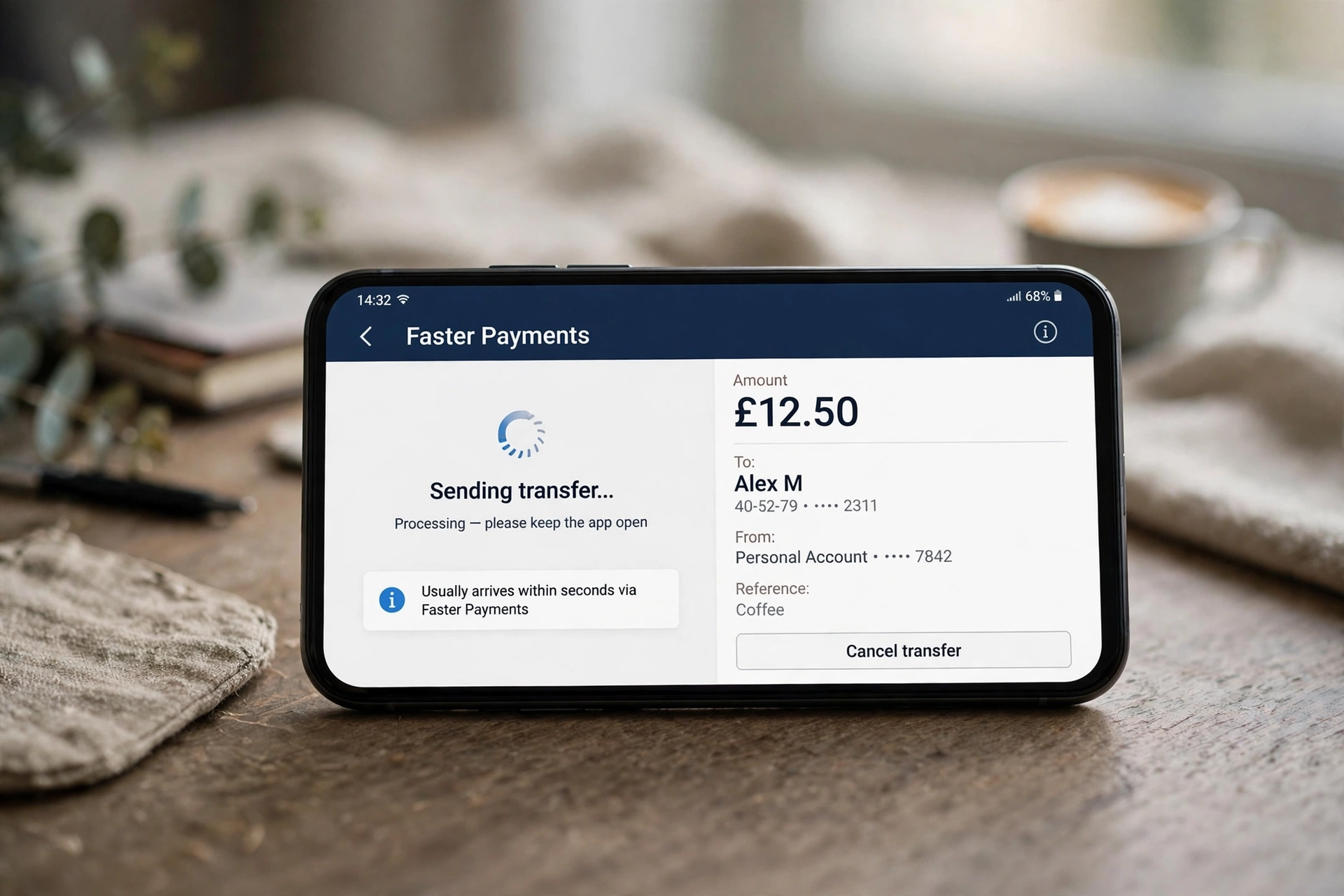
Fourth, use Faster Payments instead of a card. Card payments to exchanges are blocked at more banks than bank transfers are, and card limits are often lower. A Faster Payments transfer from your bank app is the most reliable route.
Fifth, try a smaller amount. Start with a 10 pound test payment. If it goes through, you know the route works, and you can send the rest inside your limit.
Sixth, use a second bank account if you hold one. If your main bank bans crypto transfers, an account with a bank that publishes a limit is the practical answer. Do not open an account only for crypto and then send large sums through it on day one. Banks watch new accounts closely, and a large first payment to an exchange can trigger a fraud hold.
Seventh, keep records. Note the date, the amount, the exchange, and what the bank told you. If the block causes you a loss, or if the bank gives you no reason, you can raise a formal complaint with the bank, and then with the Financial Ombudsman Service if the bank does not resolve it.
Finally, check whether the problem is the exchange, not the bank. An exchange can also reject a deposit, for example if your name on the bank account does not match your exchange account. Learn the warning signs in our Crypto Scams UK guide, and never send money to an exchange you have not verified.

How To Choose a Bank for Crypto
Choose a bank with a published limit, not a bank with no policy and not a bank with a ban. A published limit lets you plan. You know the daily cap, the monthly cap, and whether card payments count. Barclays, HSBC, NatWest, Santander, Nationwide and Monzo all publish their limits.
Match the limit to your buying size. If you buy 100 pounds a month, any of these banks will do. If you plan to move 5,000 pounds in a month, Santander’s 3,000 pound monthly cap will stop you, and Monzo’s 5,000 pound rolling allowance will only just fit. Barclays or HSBC, at 10,000 pounds over 30 days, give you more room.
Keep a second bank as a backup. Banks change their policies without notice, and a fraud check can stop a payment at any bank. A second account with a different bank means one blocked payment does not end your buying plan.
Prefer Faster Payments over card payments. Card payments are blocked at more banks, and they cost more on the exchange side too. A Faster Payments transfer is free at most UK banks, and it is the route exchanges expect.
Remember what the bank does not protect. Money in your bank account is protected by the Financial Services Compensation Scheme, up to 120,000 pounds per person, per authorised firm, since 1 December 2025. Crypto held on an exchange is not protected by the FSCS. That is a separate risk from the payment limit, and it is why we recommend moving larger amounts to a wallet you control. Read Crypto wallets guide: best wallets to use in 2026 and How to back up a seed phrase safely.
The new FCA crypto rules will not fix the banking problem. The FCA opened applications for its crypto authorisation regime on 30 September 2026, and the full regime comes into force on 25 October 2027. But the regime licenses crypto firms. It does not require banks to process payments to them. Banking access will stay a separate problem after 2027.
Frequently Asked Questions
Starling Bank, TSB, Chase UK, Metro Bank, Virgin Money and the Co-operative Bank block crypto related transfers altogether, according to the Stand With Crypto UK report of 20 October 2026. TSB has banned crypto purchases since 2021. If you bank with one of these six, use a second account with a bank that publishes a limit.
Yes, inside a limit. Barclays allows transfers of up to 2,500 pounds per transaction to crypto platforms, with a maximum of 10,000 pounds over 30 days. Barclays blocked crypto purchases on its credit cards from June 2025. Debit card and Faster Payments transfers are still allowed, inside the limits.
Lloyds publishes no crypto transfer policy, but its customers report the most blocked payments of any banking group: 2,297 complaints in the Stand With Crypto report. Payments can be delayed or declined case by case. Lloyds stopped credit card crypto purchases in 2018, and payments to Binance are stopped. Call the bank before you send a large amount, or use a second bank account.
Yes. Monzo allows crypto related transfers of up to 5,000 pounds in a rolling 30 day period. The allowance is published on Monzo’s own help page and cannot be changed. Any payment that would take you over the allowance will not go through. Monzo blocks payments to Binance. Check your total for the last 30 days before you send a payment.
Yes, inside a daily limit. Nationwide allows 1,000 pounds a day by Faster Payments and 1,000 pounds a day by debit card, per current account. You cannot use a FlexOne account or a Nationwide credit card to buy crypto. Payments to Binance using Nationwide cards are declined. The 5,000 pound daily limit quoted in older guides is from February to March 2023 and is out of date.
Do not retry the same payment again and again. Call your bank and ask whether it was a crypto policy or a fraud check, and what limit applies. Confirm your exchange is FCA registered. Use Faster Payments instead of a card. Try a smaller amount, starting with a 10 pound test. If your bank bans crypto transfers, use a second account with a bank that publishes a limit.
No. The FCA opened applications for its crypto authorisation regime on 30 September 2026, and the full regime comes into force on 25 October 2027. The regime licenses crypto firms. It does not require banks to process payments to them. Banking access will stay a separate problem, and Parliament’s Crypto and Digital Assets All Party Parliamentary Group is running a separate inquiry into it.
Conclusion
Most UK banks do not ban crypto outright. They limit it, or they block it without telling you the rule. Six banks publish a limit. Six banks block transfers altogether. Two publish nothing and still block payments case by case.
The practical answer is simple. Bank with one that publishes a limit. Know the daily and monthly cap before you send money. Use Faster Payments, start with a small test, and keep a second bank as a backup. And check the bank’s own help page on the day you buy, because these policies change without notice.
For the full buying process, read How to Buy Crypto in the UK for Beginners. For tax, read How to Report Crypto to HMRC Self Assessment. For scams, read How to Spot NFT Scams in the UK.
Disclaimer
This article is general information, not financial advice or legal advice. Bank policies change without notice. Check your bank’s own help page or call your bank before you send money. Crypto is unregulated in the UK and its value can fall sharply. Crypto held on an exchange is not protected by the Financial Services Compensation Scheme.
Sources
- Nationwide, Crypto payment restrictions: https://www.nationwide.co.uk/help/fraud-and-security/crypto-payment-restrictions/
- Monzo, Cryptocurrency Allowance: https://monzo.com/help/monzo-fraud-category/cryptocurrency-allowance
- Stand With Crypto UK, “Blocked: Britain’s Crypto Access Problem”, 20 October 2026, as reported by Decrypt: https://decrypt.co/381475/uk-banks-hit-with-10000-complaints-over-blocked-crypto-transfers-in-90-days-report
- crypto.news, Top UK banks restricting crypto transfers: https://crypto.news/top-uk-banks-including-lloyds-barclays-are-restricting-crypto-related-transfers-report/
- crypto.news, UK banks crypto complaints and payment restrictions: https://crypto.news/uk-banks-crypto-complaints-payment-restrictions/
- How2BuyCrypto, Bank Blocking Crypto Purchases? Why It Happens, What to Do: https://www.how2buycrypto.org/articles/bank-blocked-crypto-payment/
- FCA, Cryptoassets: https://www.fca.org.uk/consumers/cryptoassets
- Financial Ombudsman Service: https://www.financial-ombudsman.org.uk/