Risk warning: Ethereum is high risk and volatile. It is largely unregulated in the UK. Exchange balances have no FSCS protection. You can lose everything you invest. This guide is education, not financial advice.
Introduction
Ethereum is the second largest cryptocurrency by market value, after Bitcoin. It launched in 2015. Unlike Bitcoin, which is mainly digital money, Ethereum is a programmable blockchain. It runs smart contracts, which are small programs that power decentralised exchanges, lending apps and NFTs.
Buying Ethereum in the UK follows the same basic steps as buying any crypto. But Ethereum has its own traps. Buy it the wrong way and you pay two conversion fees instead of one. Move it without keeping any back and you cannot pay the gas fee to move the rest. Stake it without knowing the tax rule and you get a surprise at tax time.
This guide walks you through each step in order. It uses an FCA-registered exchange, Faster Payments, and a test withdrawal to a wallet you control. It shows what a £50 buy and a £100 buy cost in total. It also covers the three steps most guides skip: buying with pounds directly, keeping ETH for gas, and moving ETH to MetaMask or a hardware wallet.
If you are new to crypto in general, read our general guide first: How to Buy Crypto in the UK for Beginners. To understand what Ethereum is before you buy, see What Is Ethereum? Complete Beginners Guide. For the wider picture, see What Is Cryptocurrency? Complete Beginners Guide.
How to Buy Ethereum in the UK: The Short Answer
To buy Ethereum in the UK, open an account on an FCA-registered exchange, pass the ID check, complete the risk quiz, wait 24 hours, deposit pounds by Faster Payments, buy ETH with pounds directly, check the total fee, then send a small test amount to a wallet you control before you move the rest. Keep some ETH back for gas fees.
That is 61 words. It is the whole process. The rest of this guide explains each step, shows the cost, and warns you about the traps.
Before You Start
Ethereum is legal to buy and own in the UK. It is not legal tender. Shops do not have to accept it.
You do not need to buy a whole ETH. One ETH divides into one billion billion small units, but in practice you buy a fraction. A £50 buy is a small fraction of one ETH.
On 12 November 2026, ETH traded at about £1,550. Prices from that day ranged from about £1,533 to about £1,565 across price sites. The price changes fast. Check the live price before you buy. Do not rely on the price in this guide.
You need photo ID, proof of address, a UK bank account, and a small amount you can afford to lose in full. Do not use borrowed money. Do not use money you need for rent, bills, or emergencies.
Ethereum went through a major upgrade called Pectra in 2025, which improved wallet features and staking. You do not need to understand the upgrade to buy ETH. You need to understand the steps below.
Step 1: Check the Exchange on the FCA Register
Do this before you deposit a penny.
UK firms that exchange or safeguard cryptoassets must register with the Financial Conduct Authority (FCA) for anti-money laundering supervision. Go to register.fca.org.uk. Search for the exchange by its legal entity name, not just its brand name. Check that the status shows Registered under cryptoasset activities.
The three exchanges used in this guide, and their registered legal names and numbers, are:
| Exchange | Legal entity | FCA register number |
|---|---|---|
| Coinbase | CB Payments Ltd | 900635 |
| Kraken | Payward Ltd | 928768 |
| Bitstamp | Bitstamp UK Ltd | 978690 |
FCA registration is not the same as FCA authorisation for regulated products. It covers anti-money laundering supervision only. The FCA says that being registered as a cryptoasset business does not mean your customers benefit from the protections of the Financial Ombudsman Service or the Financial Services Compensation Scheme (FSCS).
Registration does not protect your money if the firm fails. A full FCA authorisation regime for cryptoasset firms starts on 25 October 2027. Until then, registration is the check you can make. For a full safety checklist, see How to Tell If a Crypto Exchange Is Legit: UK Safety Checklist. For exchange choice, see Best Crypto Exchange UK: FCA-Registered.
Step 2: Create an Account and Pass the ID Check
Create an account with your email address and a strong, unique password. Turn on two-factor authentication. Use an authenticator app where the exchange offers it.
You must then complete KYC. KYC stands for Know Your Customer. It is a legal requirement under the Money Laundering Regulations 2017. A legitimate UK exchange cannot serve you without it.
You will usually need a passport or UK driving licence, proof of UK address such as a utility bill, and a selfie or short video to match your face to your ID. Most checks take minutes. Some take a few hours or a couple of days. If a platform offers to skip KYC, walk away.
Step 3: Complete the Risk Quiz and Wait 24 Hours
UK rules require extra protection for first-time crypto buyers. You must complete a short appropriateness assessment, often called a risk quiz. It asks about the risks of crypto investing.
After you submit the quiz, you must wait 24 hours before you can deposit or buy. This is the cooling-off period. It exists to stop impulse buys. Use the time to read the fee page and set up your wallet. If a platform lets you buy at once with no quiz and no wait, treat that as a warning sign.
Step 4: Deposit Pounds by Faster Payments
Deposit pounds from your UK bank account. Faster Payments is the cheapest route for most UK beginners. It is usually free, and it often arrives the same day. A debit card is faster in some cases, but it costs more.
A credit card is not an option on major UK exchanges now. Older guides still list credit cards. That advice is out of date. Do not follow it.
Check with your bank before you deposit. Some UK banks limit or block transfers to crypto exchanges.
Step 5: Buy ETH With Pounds Directly
This is the step where Ethereum buyers lose money without noticing.
Go to the buy screen. Search for Ethereum, or ETH. Enter the amount in pounds, not the amount in ETH. For a first buy, £50 or £100 is enough to learn the process.
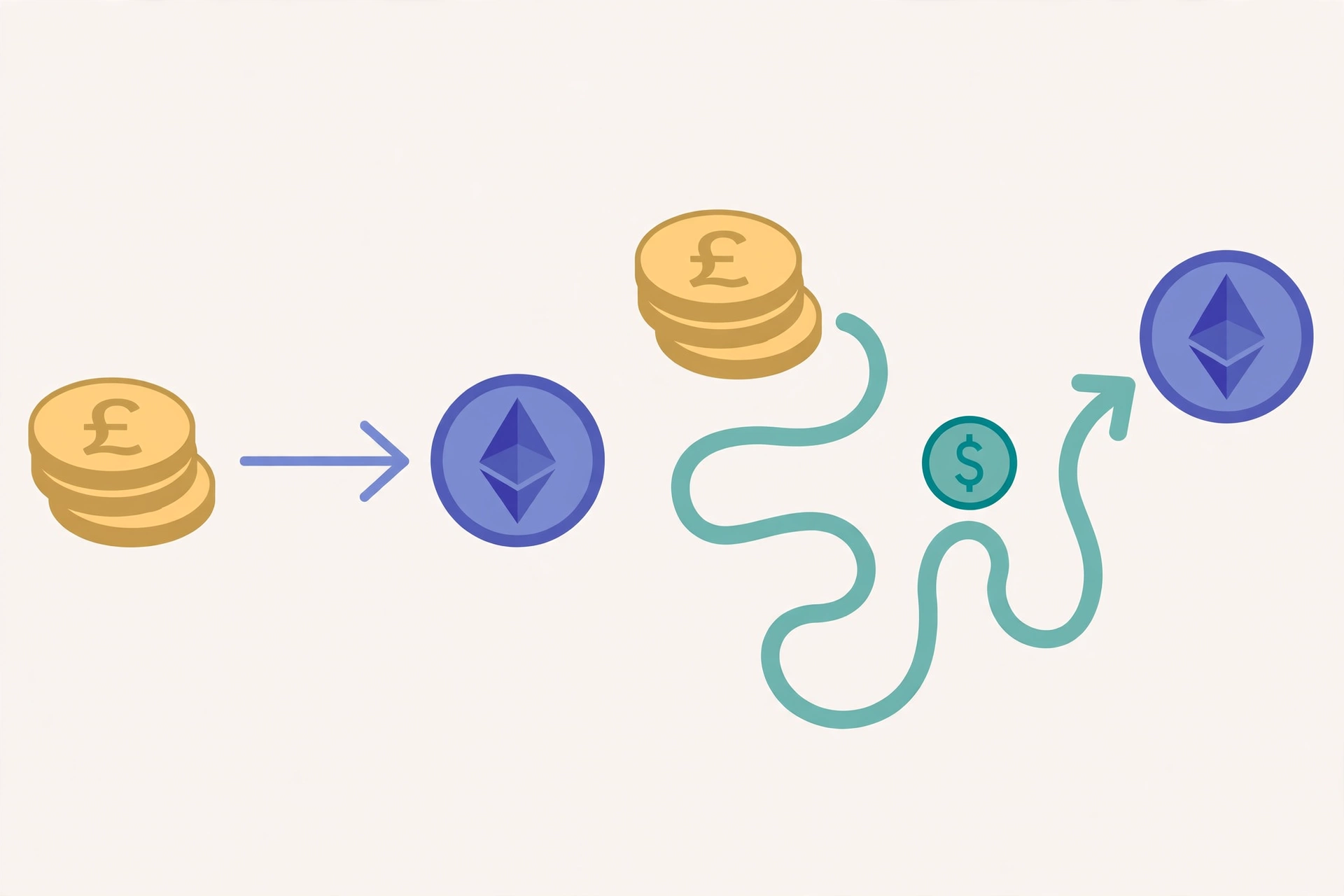
Buy the ETH/GBP pair directly. That means your pounds buy ETH in one trade. Some platforms and apps route you through a stablecoin instead: your pounds buy USDT first, then the USDT buys ETH. That is two trades, two spreads, and two fees. It also leaves you holding a stablecoin in the middle if the second trade fails. On an exchange with a direct ETH/GBP pair, there is no reason to go through USDT.
| Order type | What it does | Best for |
|---|---|---|
| Market order | Buys at once at the current price | Beginners, first buys |
| Limit order | Buys only at a price you set, or lower | Buyers who want price control |
Use a market order for your first buy. It is simple and it fills at once. A limit order may not fill if the price never reaches your set price. Use the standard buy screen, not the advanced trading view, until you are confident. Check the total before you confirm: price, fee, and the amount of ETH you will receive.
Do not buy ETH as a CFD or as an exchange-traded note if you want to own ETH. A CFD is a bet on the price, not the coin. An ETN tracks the price through a broker. This guide is about buying spot ETH that you can withdraw to your own wallet.
What a £50 and £100 Ethereum Buy Costs in Total
A buy has more than one cost. The total is the deposit fee, plus the trading fee, plus the spread, plus the withdrawal fee later. The spread is the gap between the buy price and the sell price. It is built into the quoted price on a simple buy screen.
All figures below use an ETH price of £1,550, the approximate price on 12 November 2026. Fees were checked against the exchanges’ own fee schedules and announcements on 12 November 2026. Fees change. The fee shown on your order screen before you confirm is the only figure that counts.
Order book fees (Advanced, Pro and Pro mode)
| Exchange | Maker fee | Taker fee | £100 buy, taker fee | ETH received for £100 |
|---|---|---|---|---|
| Coinbase Advanced | 0.25% | 0.50% | £0.50 | 0.0642 ETH |
| Kraken Pro | 0.40% | 0.80% | £0.80 | 0.0640 ETH |
| Bitstamp | 0.30% | 0.40% | £0.40 | 0.0643 ETH |
Coinbase cut its EU and UK Advanced fees to 0.25% maker and 0.50% taker on 16 September 2026. Kraken moved to new cross-platform tiers on 9 July 2026, with 0.40% maker and 0.80% taker at the entry tier. Bitstamp charges 0.30% maker and 0.40% taker below $10,000 of 30-day volume, under a fee schedule valid from 21 October 2026.
For a £50 buy on the same order books:
| Exchange | Taker fee | ETH received for £50 |
|---|---|---|
| Coinbase Advanced | £0.25 | 0.0321 ETH |
| Kraken Pro | £0.40 | 0.0320 ETH |
| Bitstamp | £0.20 | 0.0321 ETH |
How the maths works for £100 on Coinbase Advanced: £100 minus the £0.50 taker fee leaves £99.50. Divide £99.50 by £1,550 and you get 0.0642 ETH. For £50: £50 minus £0.25 leaves £49.75, which buys 0.0321 ETH.
Simple buy screens (Estimated)
A simple buy screen costs more. The fee is higher and a spread is built into the price.
Coinbase Simple adds a spread of about 0.50% plus a fee, with a flat fee of £2.99 reported for trades between £50 and £200. Kraken instant buy charges 1% plus a spread. Bitstamp Basic quotes a price with a fixed spread of 1.8% for most cryptoassets. These simple-buy figures are Estimated from secondary reporting of exchange fees on 12 November 2026. Check the live fee on your order screen.
| Buy | Coinbase Simple, Estimated total cost | ETH received, Estimated |
|---|---|---|
| £50 | £3.24 (£2.99 fee plus £0.25 spread) | 0.0302 ETH |
| £100 | £3.49 (£2.99 fee plus £0.50 spread) | 0.0623 ETH |
A £50 simple buy costs about 6.5% of the buy in fee and spread. A £100 simple buy costs about 3.5%. The flat fee hurts small buys most. If you plan to buy often, learn the order book. On Coinbase Advanced, the same £100 buy costs £0.50 in fees instead of £3.49.
Withdrawing pounds later
If you sell ETH and withdraw pounds, the exchange charges a GBP withdrawal fee. Faster Payments deposits are free on all three exchanges. Withdrawals cost £1.95 on Kraken and £2.00 on Bitstamp. Coinbase charges no fee for GBP withdrawals by Faster Payments, as reported in fee comparisons checked on 12 November 2026. Check the live fee page before you withdraw.
Step 6: Keep Some ETH Back for Gas
This is the Ethereum-specific step most guides skip. It catches almost every first-time ETH buyer.
Every transaction on the Ethereum network costs a fee called gas. Gas is paid in ETH. That includes sending ETH to another wallet, sending a token, and using a DeFi app. If you move all your ETH off the exchange and leave nothing behind, you cannot pay for your next transaction. Your ETH sits in the wallet and you cannot move it without buying more ETH to pay the gas.
A plain ETH transfer uses 21,000 units of gas. The gas price changes with network demand and is quoted in gwei. As an illustration only, at a gas price of 20 gwei, a simple transfer costs 0.00042 ETH. At £1,550 per ETH, that is about £0.65. This is an illustration with a stated assumption, not a live quote. Gas can cost much more when the network is busy. Check the gas estimate in your wallet before you send.
The rule is simple. Before you withdraw, leave a small amount of ETH on the exchange, or keep a small amount of ETH in your wallet that you do not spend. £5 to £10 worth of ETH is enough for several simple transfers at normal gas prices. It is not enough if gas spikes. Check the live gas price in your wallet first.
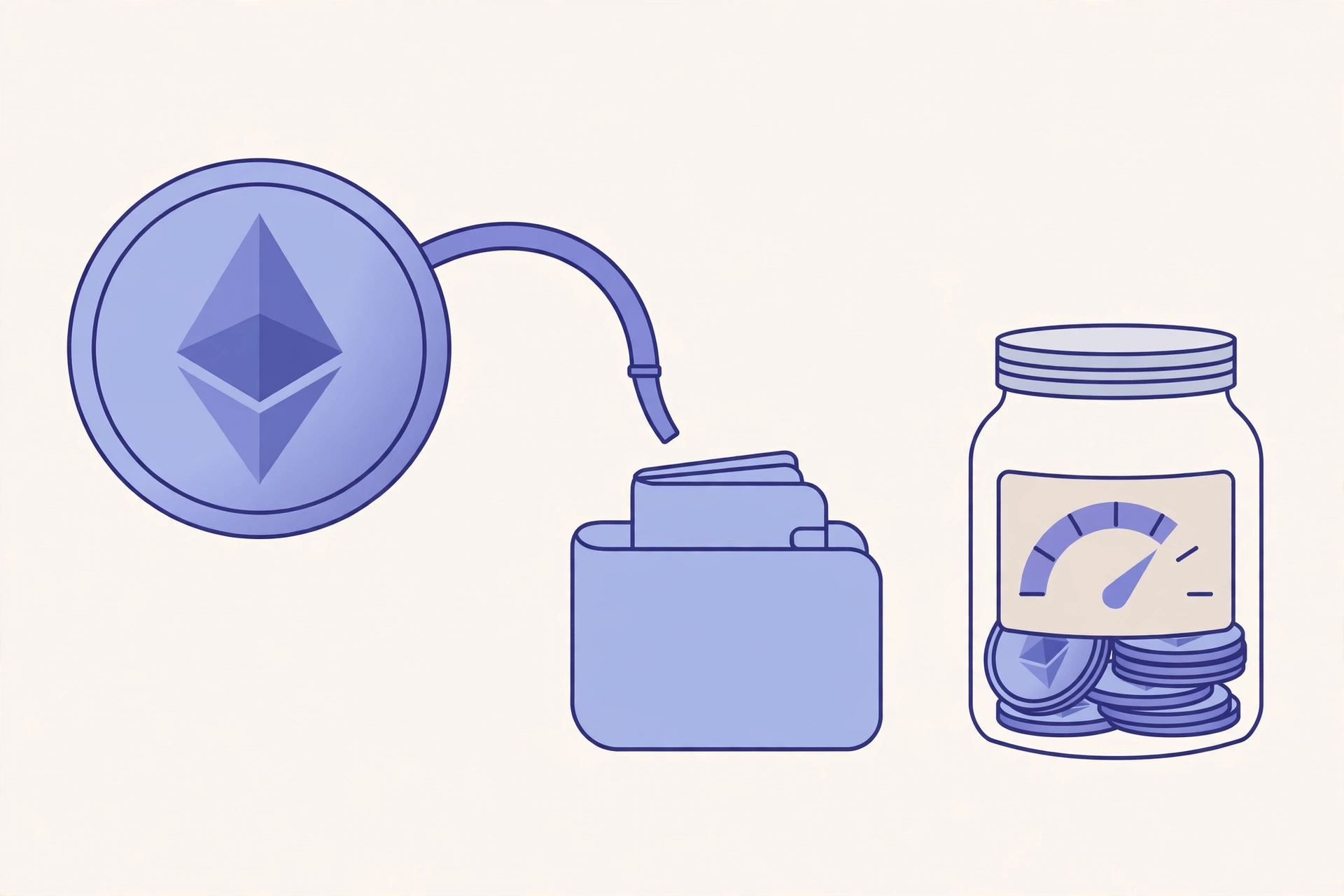
Tokens make this worse. If you hold a token such as USDT on Ethereum, you still pay gas in ETH to move it. The token itself cannot pay its own gas fee. Beginners who swap all their ETH for a token, then try to move the token, find they are stuck. Keep ETH back.
Step 7: Send a Test Withdrawal to a Wallet You Control
This is the step most beginners skip. It is the step that matters most. Until you move your ETH off the exchange, you do not really control it. The exchange holds the keys. You hold a promise. Mt. Gox, Celsius and FTX all collapsed with customer funds inside. In the UK, cryptoassets are not covered by the FSCS, so there is no safety net if a firm fails.
Set up your wallet before you withdraw. See Crypto Wallets Guide: Best Wallets to Use in 2026 and Ledger vs Trezor Hardware Wallet Comparison.
- Install a wallet app, or set up a hardware wallet, following the maker’s own guide.
- Write your recovery phrase on paper. This is usually 12 or 24 words. Store the paper somewhere safe and offline. Never take a screenshot of it. Never store it in a phone note. See How to Back Up a Seed Phrase Safely.
- Copy your ETH receive address from your wallet. Check the first four and last four characters.
- On the exchange, go to Withdraw, choose Ethereum, and paste the address. Do not type it by hand.
- Send a small test amount first. Send £10 to £20 worth of ETH, not the full balance. Check the network fee on the withdrawal screen before you confirm.
- Wait for the ETH to arrive in your wallet. Check the wallet, not just the exchange.
- Once the test arrives, send the rest in a second withdrawal. Remember to keep a little ETH back for gas.
ETH transactions cannot be reversed. If you send to the wrong address, the ETH is likely lost. That is why the test amount comes first. If you send ETH to a Bitcoin address, or Bitcoin to an ETH address, the funds are likely lost. Always check the network matches the coin.
MetaMask, if you use it
MetaMask is the most common wallet for using Ethereum apps. Install it only from the official MetaMask site or your browser’s official extension store. Never install it from an advert or a link in a message.
MetaMask uses the Ethereum mainnet by default, so your ETH address works at once. Add other networks such as Arbitrum or Base only when you need them, and only from a source you trust. A fake network entry can send your funds nowhere.
When you connect MetaMask to a website, you give that site permission to see your address and ask you to sign transactions. Check every transaction before you approve it. A common scam is a site that asks you to approve unlimited spending of your tokens. Revoke token approvals you no longer need, from inside MetaMask or a trusted approvals tool. Never share your seed phrase with any site. No real support agent will ever ask for it.
For a deeper guide, see How to Back Up a Seed Phrase Safely. A hardware wallet is the safer choice for larger amounts. See Ledger vs Trezor Hardware Wallet Comparison.
After You Buy: Staking, Tax and Records
Staking your ETH
After you buy ETH, you can stake it to earn rewards for helping secure the network. Native staking yields are in the low single-digit percentage range a year, as reported in 2026 guides. Running a validator yourself needs 32 ETH. Most beginners who stake use an exchange or a staking pool instead, which takes a cut of the yield before you see it.
Staking is not free money. Your ETH is locked while it is staked, the yield changes, and the value of your ETH can fall by more than the rewards you earn. HMRC treats staking rewards as income at the point you receive them, not as a capital gain. Keep a record of every reward, with the sterling value on the day you received it. Learn more: Crypto Staking Explained: Rewards and Risks for UK Investors.
Tax: what to record from day one
Keep a record of every buy and withdrawal from day one: date, amount in pounds, fee, ETH price, amount of ETH received, and the wallet address you sent to.
HMRC treats cryptoassets as property, not currency. You may need to pay Capital Gains Tax if you make a gain when you dispose of crypto. A disposal includes selling for pounds, swapping ETH for another cryptoasset, spending ETH, and gifting it to someone other than a spouse, civil partner or charity. Buying and holding is not a disposal by itself. The Capital Gains Tax annual exempt amount for individuals is £3,000 for 2026/27, with rates of 18% within your remaining basic rate band and 24% above it, as published on GOV.UK. Check GOV.UK for the current rates before you file.
Swapping ETH for another crypto is a disposal, even though no pounds changed hands. See Tax on Crypto to Crypto Swaps UK. This guide is not tax advice. Speak to a qualified adviser if you are unsure.
Is Ethereum better than Bitcoin?
That is the wrong question for a first buy. Bitcoin is digital money. Ethereum is a programmable platform. They do different jobs. Many UK beginners hold a little of both. Read the comparison, then decide for yourself: Is Ethereum Better Than Bitcoin?.
Common Mistakes to Avoid
- Buying ETH through USDT when a direct ETH/GBP pair exists. You pay two spreads instead of one.
- Moving all your ETH off the exchange and leaving nothing for gas. Keep a little ETH back.
- Using a credit card to buy ETH. It will not work on major UK exchanges.
- Leaving all your ETH on the exchange. Move it to a wallet you control, starting with a test amount.
- Sending the full balance in one withdrawal without a test send.
- Sharing your seed phrase. No legitimate exchange or support agent will ever ask for it.
- Approving unlimited token spending on a random website. Check every approval.
- Trusting guaranteed returns. If someone promises a fixed return, it is a scam. Our Crypto Scams UK guide (publishing soon on this site) covers the warning signs.
- Investing more than you can afford to lose, or ignoring fees. A £50 buy on a simple screen can cost over 6% in fees and spread.
FAQs
Yes. You can buy and own Ethereum in the UK. It is legal, but it is largely unregulated, and your holdings have no FSCS protection.
Yes. UK exchanges must verify your identity under the Money Laundering Regulations 2017. You will need a passport or driving licence, proof of address, and usually a selfie.
It depends on the price and the fee. At £1,550 per ETH on 12 November 2026, a £100 buy on Coinbase Advanced, after an Estimated £0.50 taker fee, buys about 0.0642 ETH. A simple buy screen costs more. Check the live price and fee on your order screen.
With GBP, directly. Buying through USDT means two trades and two spreads. Use the ETH/GBP pair on an FCA-registered exchange.
Every Ethereum transaction costs gas, paid in ETH. If you hold only tokens, or you moved all your ETH away, you cannot pay for your next transaction. Keep a little ETH back.
Yes, through an exchange or a staking pool. Running a validator yourself needs 32 ETH. Yields are low single digits a year, and the exchange takes a cut. HMRC treats staking rewards as income when you receive them.
No. The FCA states that FCA cryptoasset registration does not give FSCS or Financial Ombudsman Service cover for spot crypto. If the exchange fails, you generally have no compensation route for your ETH.
You may do, when you dispose of it. Selling, swapping, spending or gifting can be a Capital Gains Tax event. Staking rewards are income when received. Keep records from your first buy, and check GOV.UK or speak to a qualified adviser.
Conclusion
Buy Ethereum in the UK in this order: check the FCA Register, pass KYC, complete the risk quiz, wait 24 hours, deposit by Faster Payments, buy ETH with pounds directly on the ETH/GBP pair, check the total fee, then send a test withdrawal to a wallet you control.
Know the cost before you confirm. A £100 buy on an order book costs £0.40 to £0.80 in trading fees on the three exchanges in this guide. A £100 simple buy can cost about £3.49. Buy with pounds directly, keep a little ETH back for gas, and do not leave all your coins on the exchange.
Ethereum is high risk and volatile. It is largely unregulated in the UK. Exchange balances have no FSCS protection. You can lose everything you invest. Only use money you can afford to lose in full.
Sources
- FCA, Cryptoassets: AML / CTF regime: https://www.fca.org.uk/firms/financial-crime/money-laundering-terrorist-financing/cryptoassets-aml-ctf-regime
- FCA Financial Services Register: https://register.fca.org.uk/
- GOV.UK, Check if you need to pay tax when you sell cryptoassets: https://www.gov.uk/guidance/check-if-you-need-to-pay-tax-when-you-sell-cryptoassets
- GOV.UK, Capital Gains Tax rates and allowances: https://www.gov.uk/guidance/capital-gains-tax-rates-and-allowances
- Coinbase, We are lowering fees for many active traders on Coinbase Advanced (16 September 2026): https://www.coinbase.com/blog/were-lowering-fees-for-many-active-traders-on-coinbase-advanced
- Bitstamp fee schedule: https://www.bitstamp.net/fee-schedule/
- ExchangeAtlas, How to Buy Ethereum in the UK in 2026: Step-by-Step Guide: https://www.exchangeatlas.io/guides/how-to-buy-ethereum-uk-guide/
- 99Bitcoins, How to Buy Ethereum in the UK: https://www.99bitcoins.co/guides-and-tutorials/how-to-buy-ethereum-uk/
- WhichBroker, Kraken fees explained (UK): https://www.whichbroker.io/guides/kraken-fees-explained
- Bitunix, Best Crypto Exchange UK 2026: Fees, FCA Rules and Alternatives: https://www.bitunix.plus/hub/blog/trading/best-crypto-exchange-uk
Fee Verification Note
Fees checked 12 November 2026. Coinbase Advanced EU and UK fees of 0.25% maker and 0.50% taker come from Coinbase’s own announcement of 16 September 2026. Kraken Pro fees of 0.40% maker and 0.80% taker and the £1.95 GBP withdrawal fee were checked against Kraken’s fee schedule as reported on 23 October 2026. Bitstamp fees of 0.30% maker and 0.40% taker and the £2.00 GBP withdrawal fee come from the fee schedule valid from 21 October 2026. FRNs 900635, 928768 and 978690 were verified against the FCA register on 12 November 2026. The ETH price of about £1,550 is the approximate price on 12 November 2026. Simple buy figures are Estimated from secondary reporting. Check the fee shown on your order screen and withdrawal screen before you confirm. Do not treat any fee figure here as live.